04 / Physical infrastructure
Olive Farm Project
Making a rural property work without a technician nearby.
- Status
- Long-term project
- Location
- Homs countryside, Syria
- Focus
- Water, power, monitoring
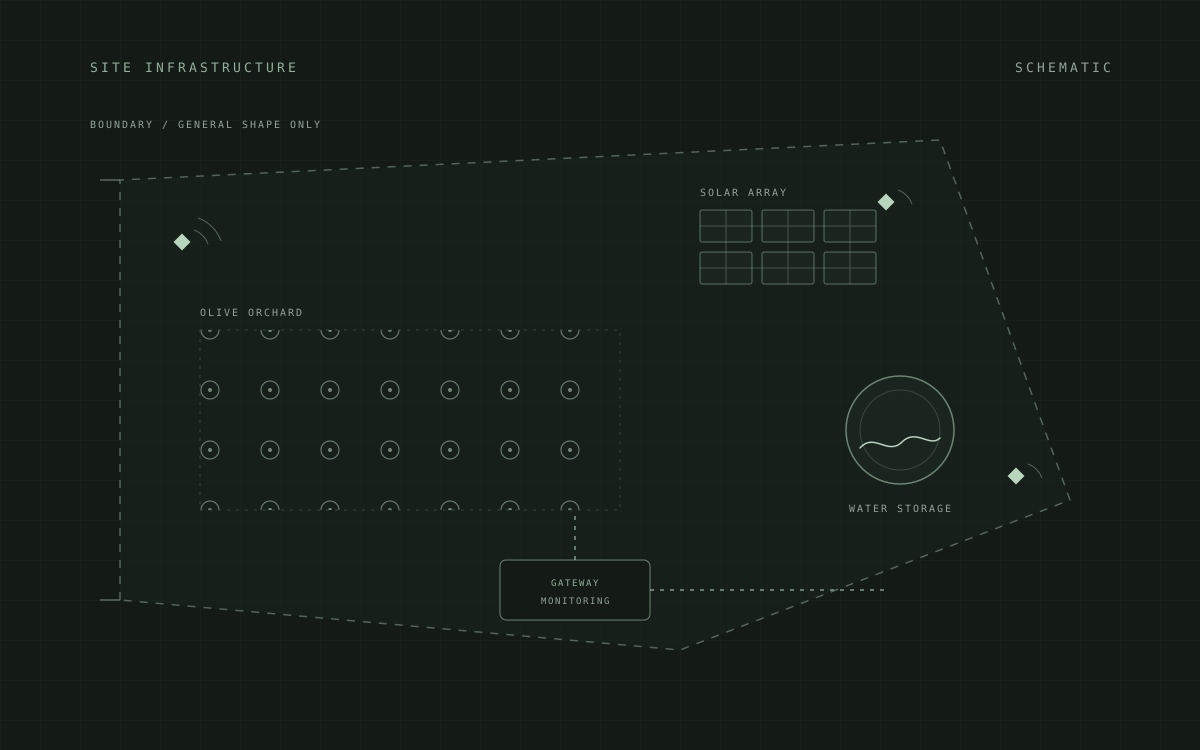
This is a long-term project on a rural property in the Homs countryside. The work is practical: develop and maintain an olive orchard, plan reliable water infrastructure, move toward solar power, and make it possible to understand what is happening on the land from a distance.
The constraints shape everything. Power is intermittent, connectivity is limited, and nobody is standing by to restart a service. Solutions have to be simple enough to maintain locally and robust enough to survive being ignored for a few weeks.
It is also a different kind of engineering from software. Physical systems fail slowly, visibly, and expensively. That changes the design approach.
What it covers
Olive orchard development
Long-term work on the health, structure, and productivity of the orchard.
Water infrastructure planning
Storage, distribution, and irrigation planned around what the land and the season actually require.
Solar power planning
Reducing dependence on an unreliable grid, starting with the loads that matter most.
Remote property monitoring
A practical way to see the state of the property without being there, starting with the essentials.
Cameras and lighting
Basic security infrastructure designed to function with limited bandwidth and power.
Connectivity challenges
Working within intermittent mobile coverage and building systems that tolerate gaps rather than assuming a stable link.
Technical notes
Design for interruption
Every system on the property has to assume that power will cut out and the network will disappear. That rules out a lot of otherwise reasonable architectures and pushes toward local storage, local processing, and graceful degradation.
The test is not whether something works when everything is nominal. It is whether it comes back correctly after a week of no attention.
Monitor first, automate later
Automation without visibility is a liability. The early phases focus on measurement: is there water, is there power, is anything obviously wrong. Control can come after the picture is trustworthy.
Physical systems teach patience
In software, a fix can ship in minutes. Here, a fix may require a delivery, a season, or a person on site. Planning around that reality has made me a more conservative engineer in other work too.
What comes next
- 01Complete the current phase of water storage and distribution work.
- 02Size a solar system around the property's actual critical loads.
- 03Establish reliable remote visibility before adding any automated control.
The exact location, layout, and security configuration of this property are deliberately omitted from this site. Only the general scope of the project is described.